State of the Nation: England facing ‘ugly post-mortem’ as Steve Borthwick regime left answering ‘existential questions’


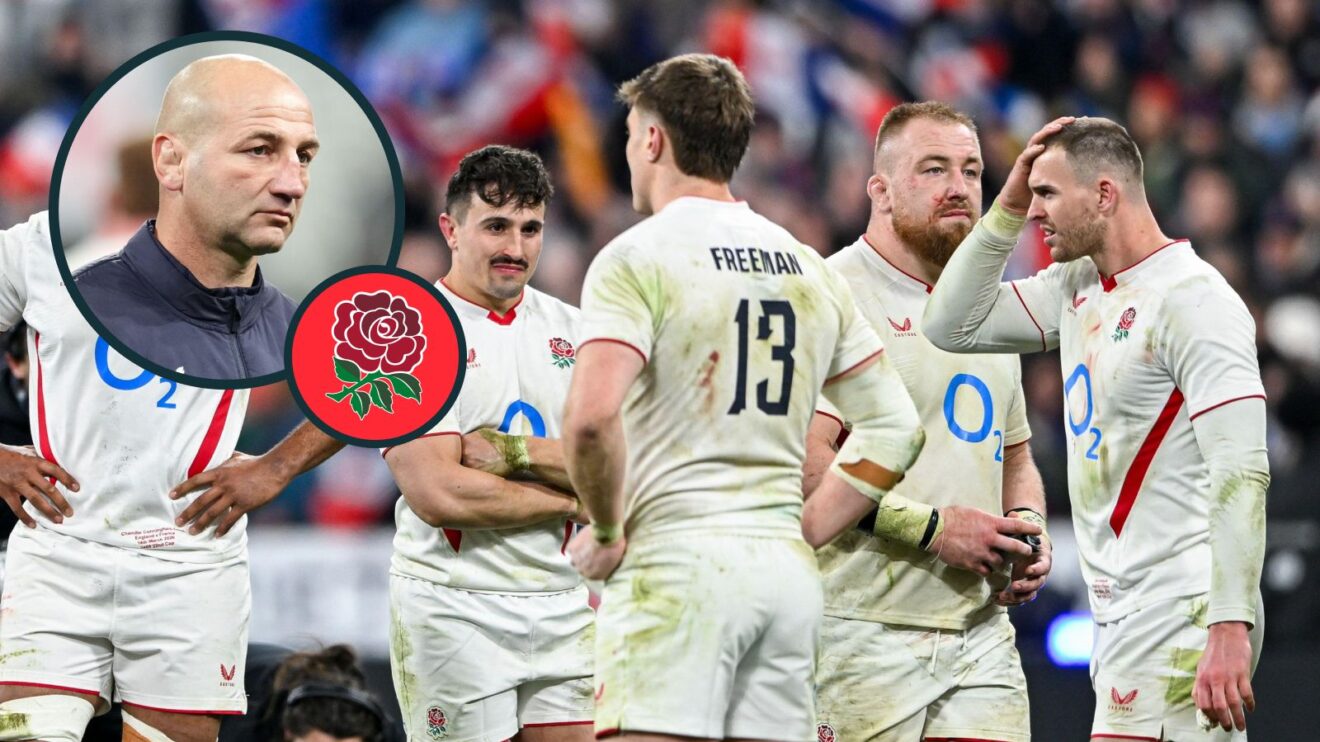
England players following their defeat to France in Round Five of the 2026 Six Nations and an inset of Steve Borthwick
Following the conclusion of the 2026 Six Nations, we update you on the state of the participating nations. Next up, it’s Steve Borthwick’s England.
England came into the Championship with the title very much in their sights after a run of 11-straight Test victories across 2025, and this felt as good a chance as any for them to lift the title for the first time since 2020.
Wales, Scotland, Ireland and Italy seemed to just be speed bumps on the way to a Grand Slam decider in Paris against France in the final Test of Super Saturday, with Borthwick himself issuing a rallying cry to his side to get themselves in a position to win it on the final day, but it turned out to be anything but plain sailing as they slumped to just one win from five.
That run of form now not only marks this as England’s worst-ever Six Nations campaign and sees them tumble down from third to sixth in the world rankings, but it leaves the RFU and Borthwick facing an ugly post-mortem moving towards the inaugural Nations Championship.
Six Nations summary
Borthwick’s side began their campaign with a Test against Wales, which gave them the perfect chance to lay out some early title credentials. But the visitors were also keen to make some big steps forward after a tough Autumn Nations Series campaign, and a Test against England would have been the best way to do just that.
In keeping with their November form, though, England hit the ground running. George Ford’s boot again opened the scoring, with the fly-half knocking over an easy penalty after just two minutes, and that was a sign of how the day would pan out for the hosts.
Making the most of Wales’ two yellow cards, winger Henry Arundell had completed a fine hat-trick by the 35th minute, while Ben Earl also crossed the whitewash in between his scores to put England 29-0 up at the half-time break.
More of the same followed for England after the break, with Tom Roebuck adding his side’s fifth of the Test on the 44th-minute mark, Wales did get one back part-way through the half as Josh Adams dotted down, but it was mere consolation as England again made Wales pay for their ill-discipline with a penalty try and an effort from Tommy Freeman late in the day to come out 48-7 victors.
All seemed well after that win. All seemed like it was on-script ahead of a possible Grand Slam tilt, but it quickly turned sour.
Edinburgh has not been a happy hunting ground for England sides in recent years, with their last victory north of the border coming in 2020. The build-up was centred around England ending their hoodoo, made even stronger by Scotland losing their opener to Italy in the Rome monsoon and the increasing pressure on head coach Gregor Townsend, but it panned out entirely differently.
The hosts, who had an early man advantage after Arundell was shown a yellow card, raced out to a 17-0 lead after just 15 minutes thanks to scores from Huw Jones and Jamie Ritchie as well as the boot of Finn Russell, a scoreline which quickly became 24-10 as Arundell and Ben White exchanged tries either side of a Ford penalty. The Bath winger would see his shift come to an early end minutes before the break, though, copping a 20-minute red card for a challenge in the air.
That man advantage allowed Scotland to get a stronger grip on the Calcutta Cup as Jones raced away for his second try of the match, and while England did mount a late fightback, Earl’s try came too late in the day to change the outcome as Townsend’s side took the spoils.
A loss in the early rounds of the Six Nations is certainly a blow, but England headed into round three with the title still in sight despite that defeat to Scotland. But, their hopes were soon blown out of the water by Ireland.
Andy Farrell’s side again condemned England to an early deficit. Jack Crowley opened the scoring with the boot, before Jamison Gibson-Park, Rob Baloucoune and Tommy O’Brien crossed the whitewash in the opening 30 minutes to make it 22-0. Fraser Dingwall’s score on the stroke of half-time did suggest England were coming back into it, but Ireland again hit their straps in the second-half, with Dan Sheehan and Jamie Osborne dotting down. England did get two of their own through Ollie Lawrence and Sam Underhill, but it was again too little too late as Farrell’s side secured a resounding 42-21 win to all-but end England’s title chances.
Italy were up next, and while many England fans were hoping for a bounce back against the Azzurri, the hosts plunged Borthwick’s side deeper into crisis.
It was nip-and-tuck across the Test, with Paolo Garbisi’s boot opening the scoring after 20 minutes before Tommy Freeman and Tommaso Menoncello exchanged scores, but a late Roebuck score in the final play of the half saw England take a two-point lead into the sheds.
Two points quickly became eight as Fin Smith slotted two penalties in the early moments of the second-half, but that would be the end of the England scoring. Again, ill-discipline came back to bite them as Italy hit with two penalties of their own to make it 18-16, before they landed the sucker-punch in the 73rd minute through Leonardo Marin, a try which secured them a slice of rugby history with their first-ever win over England.
It was a defeat that turned England’s blip into a full-blown crisis, and they were left staring their worst-ever Six Nations finish with just one win from five in the face. Their only hope was to beat France. Easier said than done.
But it so nearly panned out that way.
The latest edition of Le Crunch was an absolute blockbuster from start to finish, with 13 tries scored across the Test, and it going down to the final kick of the Championship as well.
Tries were being scored for fun across the Test, with neither side able to stop the other. Louis Bielle-Biarrey had two after just 12 minutes, sandwiched between scores from England’s Roebuck and Cadan Murley. Back-to-back scores from Ollie Chessum and Alex Coles gave England a healthy advantage heading into the final moments of the half, but a penalty try for Les Bleus on the stroke of half-time meant the visitors held a three-point lead at the break.
That flurry of action continued in the second-half, too, with Bielle-Biarrey adding his third and fourth of the night either side of a Theo Attissogbe score, while England again crossed through Chessum, Marcus Smith and Freeman. That late score from the centre seemed to do the business for England, but in the final play of the Championship, Ramos stepped up to win France the title.
England, though, while vastly improved, were handed their worst-ever Six Nations finish.
Standout players
England’s campaign was not littered with standout performers, given their form, but there are certainly some pushing their names above the rest.
If there were any lingering doubts about the number eight shirt for England, Ben Earl has now surely nipped that in the bud. The back-rower was head and shoulders England’s best player across the five Tests, arguably one of only a handful who end the campaign in genuine credit as well.
He was just a menace across the park, serving as his side’s main ball-carrier in both the loose and the tight and always looked to make a difference at the breakdown too.
It’s clear that he has become the beating heart of their pack, and he will likely have a huge role to play in the future direction of this team.
Has defence got worse, or has attack got better? The evidence behind the broken records
Tighthead did seem a problem area heading into the Six Nations with both Will Stuart and Asher Opoku-Fordjour ruled out of the campaign, but Joe Heyes proved himself as a real Test animal.
The Leicester prop, who has been rapidly improving across the past few years after early flirtations with the Test squad, just nailed all the fundamental parts of his role and proved a rock of consistency in an otherwise trying campaign.
His work in the scrum was exceptional, besting some decent looseheads in the process while also providing the anchor to allow Ellis Genge to go for the jugular, and had some really strong moments around the park too. It will take some doing to get him out of the shirt now.
There was a lot of talk around how England would use Tommy Freeman, given his public desire to switch to the centres, but he enjoyed a really strong campaign in his new position and could be their go-to man here for a while as a result.
As previously discussed, his style of play is more akin to a rugby league centre than a traditional rugby union 13, coming in hard against the grain and adding consistent strike as a result, and it worked more often than not.
His ability to get consistent gainline was instrumental in both their standout performances against Wales and France, and he was one of a few bright sparks against Scotland and Italy too.
Yes, he is still getting bedded into the position, but he seems to really suit it.
Stat leaders
When looking into the numbers, two names kept cropping up. Freeman and Earl.
The back-rower was again England’s chief ball-carrier across the Championship, making the most carries of any player across the Six Nations with 94 to his name, alongside a total of 270 metres in the process – the most of any forward across the campaign as well. Within Earl’s metres, 111 of them came post-contact, another Championship high for the Saracens man.
He is also only bested by the Saints back in terms of metres-made as well, with Freeman making 301 for his efforts. The Northampton Saint also beat the most defenders of any English player this Six Nations, with 19 tallied across his five outings, while making a team-high 11 linebreaks across the campaign.
Both men also feature high up the list for dominant carries, as well, with Freeman second across the Six Nations with 18 and Earl just behind on 17.
If there was ever a reflection of the importance of those two players, it’s that.
Want more from Planet Rugby? Add us as a preferred source on Google to your favourites list for world-class coverage you can trust.
Around them, Henry Arundell’s early try-scoring exploits saw him finish the campaign third in the table across the Six Nations, with four to his name, while Tom Roebuck also cracked the top 10 with his tally of three tries. George Ford also finished as England’s highest points scorer, with 27 to his name. He also knocked over 12 kicks from the tee.
On the defensive side of the ball, England captain Maro Itoje finished with a tally of eight turnovers, seeing him joint-top of the Championship alongside fellow British and Irish Lions Tadhg Beirne.
Success story
There won’t really be masses of positives for Borthwick to identify when reviewing the Championship, given it was their worst-ever finish, but the scrum will surely be a standout.
England have really put an emphasis on their scrum in recent times, particularly since the arrival of coach Tom Harrison, and they really bore the fruit of those efforts this Championship.
Genge and Heyes seemed to form a deadly synergy with one another on either side of the scrum, with the pair going at it in a very similar way. They didn’t go for the all-out attack approach that Italy and France did, but rather bided their time, held their shape and waited for a glimmer. When the time came, they snapped into action, with Genge leading the hunt.
Together, they became penalty-milking machines, forcing experienced props to be folded like deckchairs in the process, and gave England a consistent platform in the process.
A lot of England’s good bits came as a result of scrum penalties, turning them into territory from pretty much nowhere and creating chances to score off the back of it; and while they didn’t capitalise as they did in the Autumn Nations Series, the scrum did its job.
The scary thing is that England were also dealing with a major propping crisis heading into the Championship, with the aforementioned Stuart and Opoku-Fordjour joined by Fin Baxter on the unavailable list, and they still managed to deliver some huge scrummaging efforts.
The true acid test of where this scrum is will come against the Springboks in July, the team that set the blueprint for the modern Test pack, but that clash should produce fireworks.
Main regret
England came into the Championship as one of the favourites, if not the favourite, to win the title after 11 successive Test victories, which turned to 12 in round one after thumping Wales, but it quickly unravelled, and that will leave Borthwick regretting what could have been.
The speed and sheer totality of the regression will send alarm bells ringing for both the players and the coaching staff. They just seemed a shell of the side that took to the field in 2025, and it was largely the same cohort as well.
England have endured some rocky patches in Borthwick’s tenure, but 2025 seemed to suggest that was a thing of the past. The issues that saw them lose repeated close Test matches against Tier One sides in 2024 seemed to be ironed out, but now it’s arguably worse.
Borthwick’s side looked at sea at times, on both sides of the ball. Scotland’s and Ireland’s attacking intent, speed of ball, desire to play wide and ability to slightly shift the point of contact left the defence chasing shadows on both occasions, while the Italian defeat came about due to a mix of poor reads and an inability to deal with the high-ball. It was much better against France, but then again, they shipped 48 points.
The defence isn’t actually the main concern, though. That is inevitably going to be on the back foot given the sudden and drastic shift towards attacking game plans this Championship – even Shaun Edwards was taken aback – and they are still going through a transition with Richard Wigglesworth leading the defence now. The main concern is the attack.
England’s kicking game was masterful in the Autumn Nations Series, driving them to four wins from four, but it came undone this Six Nations. Looking across the competition, England actually don’t kick as much as their rivals, but it’s the way their rivals use it that has England’s system under the spotlight.
France are the perfect example, with Les Bleus making the most kicks and most kick-metres this Six Nations, but they only kicked to carry on the attack and unlock the defence. Matthieu Jalibert’s and Antoine Dupont’s ability to scan for cracks in the defensive line was perfect for this, with them both kicking in behind their opposition to continue the attack and work through the phases.
For Les Bleus, it’s just another part of their attack, but England’s kicking game was the totality of their attack, and when it misfired, they had no plan B, and it cost them.
This Championship was just a major regression from where England were in 2025, and it potentially leaves Borthwick with some existential questions about his regime and the direction of the side
Results
England WON 48-7 v Wales (London)
England LOST 31-20 v Scotland (Edinburgh)
England LOST 42-21 v Ireland (London)
England LOST 23-18 v Italy (Rome)
England LOST 48-46 v France (Paris)