Saracens v Northampton: Five takeaways as Saints come out on top in ‘a game of moments’ while ‘the arithmetic is uncomfortable’ for Sarries


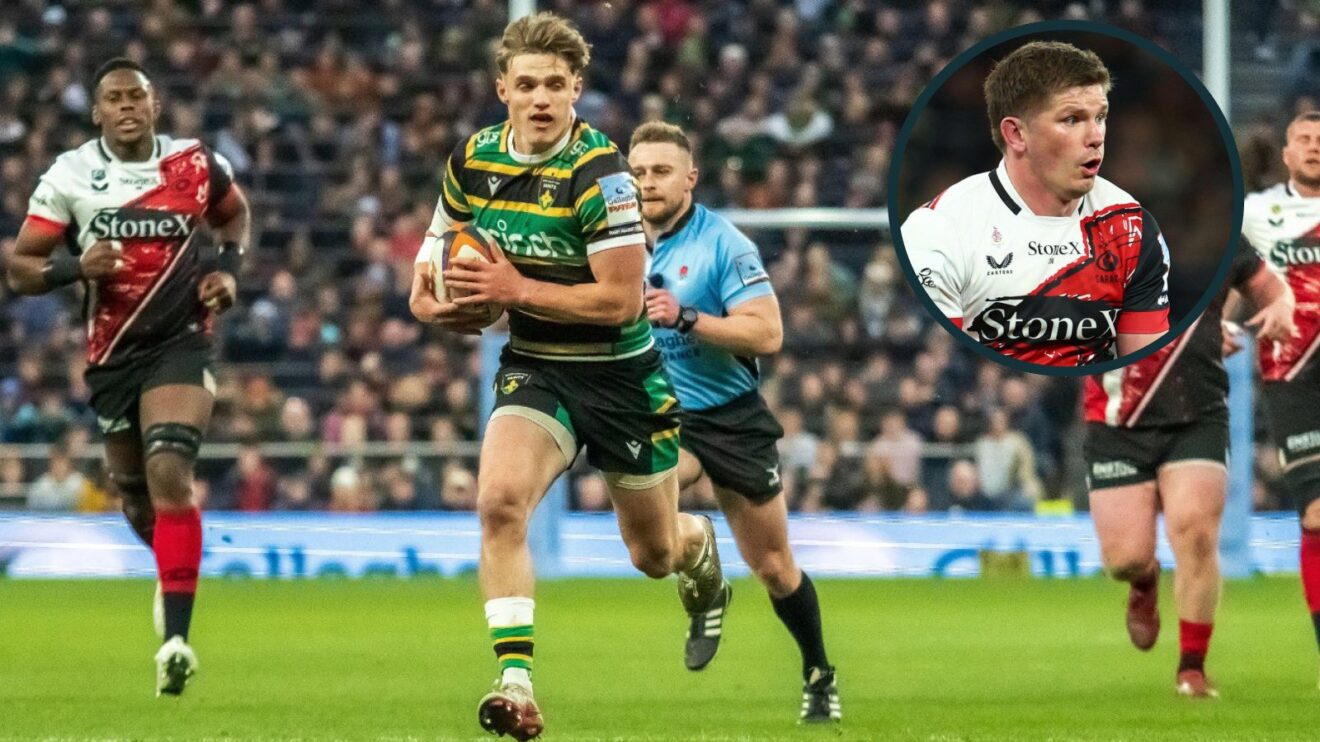
Northampton Saints scrum-half Archie McParland and Saracens playmaker Owen Farrell (inset).
Following Northampton Saints’ 21-17 win over Saracens in Saturday’s Showdown 6 at Tottenham Hotspur Stadium, Planet Rugby picks out five takeaways from the thrilling action.
The top line
On the final lap of Premiership Rugby’s Big Match Bonanza, the night demanded a finish and Northampton Saints delivered one. In front of 54,000 at a magnificent Tottenham Hotspur Stadium, the largest crowd of an extraordinary triple-header Saturday, Saints produced the kind of closing passage that defines seasons. George Furbank read the moment, Fraser Dingwall held on, Luke Green ran the decoy and Archie McParland scored the try that won it. The East Midlands roared in North London, Tom Pearson collected a richly deserved player of the match award and Saints moved six points clear at the top of the Premiership table. Tries from Tom Litchfield and a brace from McParland did the damage for Saints, with Tobias Elliott and Theo Dan responding for Saracens.
The implications reach well beyond North London. Saints move six points clear at the top, a statement built on the resilience to win without their most important player against a side with the firepower to hurt anyone. For Saracens the arithmetic is uncomfortable. Thirty points remain to play for and they need the bulk of them simply to reach the play-offs. Last season they had two more points at this stage and still fell short. Exeter in fourth are pulling away. Leicester in third are consolidating. Mark McCall’s side played with real fight and deserved more than they got, but sport does not deal in deserving. Fergus Burke’s penalty gave them the lead. McParland’s second try took it away. That is the margin on which seasons turn.
This was a match that had everything: a 15-on-15 brawl described by referee Anthony Woodthorpe as “a little bit extreme” in the understatement of the season, a giant held up twice over the line, a half-time HIA that changed the contest’s complexion, and a finish the occasion deserved.
A game of moments
This match will be remembered not for its scoreline but for the moments that shaped it, and no moment was more emblematic than JJ van der Mescht’s evening. The South African behemoth carried like a wildebeest on the hoof, swatting Saracens defenders aside with a casual brutality that suggested a try was simply a matter of time. He was held up once. He was held up twice. Twenty-three stones of snorting determination denied by the detail, the ball never quite finding the ground when it mattered most. He did not get his try. He got something arguably more valuable: the knowledge that his carrying created the platform from which McParland scored the winner, the match summed up in one man.
Burke’s penalty with eight minutes remaining put Saracens ahead for the first time, the Kiwi cool under the most intense pressure, and for a moment it seemed as though Saints would pay the price for losing Fin Smith to an HIA at half-time. The conductor gone, the system stuttered. Saracens ground and ground, injecting power through their bench, Farrell arriving at every collision with the hunger of a man with something to prove. The brawl, when it came, was described by Woodthorpe as “a little bit extreme.” It was the understatement of the season. A weight training session disguised as a rugby match had finally boiled over.
Then McParland scored his second, Litchfield the architect, JJ’s carry doing the hard yards that set the platform, and the try arrived to shake the stadium. Saints had their moment. They took it with both hands.
Northampton Saints: Identity beats stardust
There is a recurring argument in rugby that talent wins matches and coaching wins titles. Northampton Saints are making the most compelling case in the Premiership this season that the second half of that equation matters more than the first.
Saracens arrived at Tottenham Hotspur Stadium with Owen Farrell, Elliot Daly, Maro Itoje, Nick Tompkins, Tom Willis and Rhys Carré. They are a side stuffed with rugby superstars, coached well and aware of their own firepower. When they needed their big-game players in that first-half comeback, Farrell put his body on the line, Daly finished with power and Carré’s left-handed offload showed the dexterity of a player in the form of his life. Willis and Tompkins brought the physical collisions Saracens needed to claw their way back. They are genuinely formidable.
Northampton have something different and, in many ways, more valuable. Sam Vesty and Phil Dowson have constructed a team with a genuine identity, a clarity of purpose that runs through every position and every decision. Litchfield screaming through a line as the ball arrives perfectly in front of him. McParland finishing with the instinct of a player who knows exactly where he needs to be. Furbank reading space in the wide channels with the composure of a genuine international. Dingwall covering seamlessly for Smith without the system missing a beat. The losing of their conductor hurt, briefly. The identity held.
Star men
Itoje was, as he so often is on the biggest occasions, extraordinary. His breakdown work, his aerial presence and his ability to lift those around him carried the hallmarks of a player who does not know how to perform below his ceiling. Alongside him, Carré carried his Six Nations form seamlessly into the club game, physical and technically demanding throughout. Then came the moment that captured everything about Saracens at their most dangerous: a planned move, Carré introduced into the back line, the left-handed offload quite remarkable for a loosehead prop, the ball finding Farrell who found Daly, the bounce pass doing what bounce passes always do. Carré executed his role with the assurance of a man in the form of his life.
Elliott brought clinical finishing and Dan was very good indeed, busy and accurate throughout, while Farrell was a defensive monster, arriving at every collision with the hunger of a man with something to prove. Daly was, as he can be, a mixture of the brilliant and the baffling; when the ball went to hand in traffic you occasionally wondered what he was actually looking at.
For Saints, Furbank was outstanding and Steve Borthwick would do well to take note. The full-back brought genuine balance to Northampton’s attack, exploiting space with the composure and footballing intelligence that the England position currently lacks, his reading of the wide channels a consistent source of progress throughout an evening that demanded exactly those qualities.
Pearson was player of the match and the award was thoroughly merited. While Henry Pollock attracted the cameras and the headlines, Pearson did the grinding, unglamorous, match-winning work that coaches prize above almost everything else. His jackal threat was constant, his carrying purposeful and his physical presence in the collisions was a thread running through everything Saints achieved tonight. England are overlooking him. That oversight is becoming increasingly difficult to justify.
And then there is Pollock. A man never knowingly under-photographed, rugby’s most visible (and at times, cringeworthy) presence on and off the field. But here’s the thing: 14 carries, 40 metres made, four turnovers. The numbers are genuinely substantial and the energy he brings is something his teammates clearly feed off. He works hard, sticks his head in and grafts with real commitment.
A special mention for the subplot nobody should overlook: Danilo Fischetti and Marco Riccioni, best mates and Italian Test partners, going head to head off the bench with genuine ferocity. Fischetti, whose Instagram goes by the glorious nickname Cuba Medusa (The Box Jellyfish) was impactful and abrasive throughout and Riccioni responded in kind. Two friends, one contest, no quarter given, but many hugs and kisses after the whistle.
Want more from Planet Rugby? Add us as a preferred source on Google to your favourites list for world-class coverage you can trust.
The Big Game Weekend: A concept coming of age
Premiership Rugby’s decision to cluster three marquee fixtures into a single Saturday has produced something genuinely exciting. The Slater Cup at Villa Park, Bristol’s Big Day Out at the Principality Stadium in Cardiff and Showdown 6 at Tottenham Hotspur Stadium represent a collective statement of intent that the league can occupy iconic venues and fill them with purpose.
The numbers tell their own story. Villa Park drew 23,000 on a sunny afternoon in Birmingham. Cardiff’s Principality Stadium hosted a double-header of men’s and women’s rugby in front of around 44,000, building impressively on last season’s record crowd of 51,095 at the inaugural Big Day Out. Tottenham Hotspur Stadium brought 54,000 through the turnstiles for Saracens and Northampton Saints. On any measure, well over 120,000 people watched Premiership Rugby live today. That is a number the sport should shout about loudly and without apology.
The one challenge worth raising is whether concentrating all three events on the same weekend dilutes the cumulative footfall and media attention each fixture deserves. Spread across three separate weekends, each occasion commands its own news cycle, its own build-up, its own moment in the spotlight. As a triple-header, do they compete with each other for oxygen? It is a question of strategy rather than criticism. The concept is outstanding, but the scheduling conversation is one worth having.