Loose Pass: Champions Cup ‘desperately needs a reset’ after ‘unsurprising’ weekend and why a Spanish World Cup MUST happen


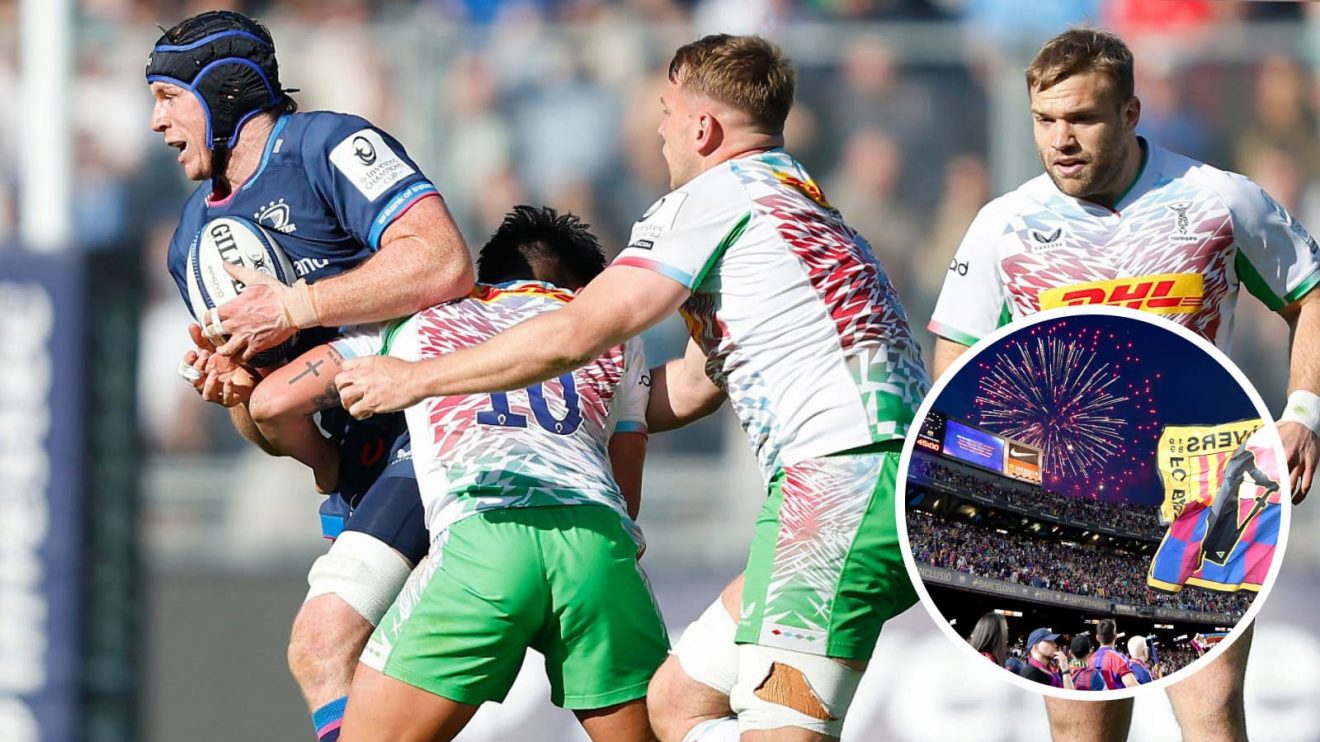
Caelan Doris was part of Leinster's 62-0 demolition of Harlequins on Saturday.
This week we will mostly be concerning ourselves with the vanishing mystique of the Champions Cup, the rebirth of Super Rugby, and the prospects for a distant World Cup…
Munster the poster boys for a long-lost age
That the Champions Cup in its current state is not what it was is no secret. Teams field weakened squads for the knockout stages, two or three teams hold all the trump cards (even with the best player in the world injured) and when the biggest story of the weekend is a parachutist getting stuck on the roof, you know that something is amiss.
There were plenty of vibrant occasions at the weekend, plenty of spectacles and fun days out, but Toulon running Saracens ragged 59-7 over 50 minutes, Leinster running Harlequins 62-0 over 80, Toulouse running 30 unanswered points against Sale over the course of an hour… none of these felt like contests; more pertinently, none of it felt like a surprise either.
It’s traditionally been tough to win on the road in Europe, tougher still now that Africa is in the equation. But then when you can qualify for the last 16 with only two wins – one in one case this season – who needs to travel anyway? And when clubs come to examine priorities at the end of a long, long season, which is the common sense choice, sending all the battered and bruised on a tough day out in Toulon or waiting for the winnable games to take you to a money-spinning tilt at the domestic Premiership?
The only game of the weekend that still captured the feeling of the good old days of the Heineken Cup was Munster‘s edgy win in La Rochelle – for the sheer drama of the rugby you can add Castres’ epic victory over Benetton into that equation. The others felt like home processions, partly because of the sheer strength that French teams and Leinster have been able to amass, but also partly because it no longer feels like the zenith of all clubs’ aspirations once you get to the end of the season.
Mostly it feels like a competition to see who has the deepest resources. Toulouse, for the decisive final quarter, were able to bring on Anthony Jelonch, Paul Costes and Juan Cruz Mallia. Sale’s only international caps on the bench were those of prop WillGriff John. Good for the clubs who have such resources, but wouldn’t you rather it felt more like which team was the best when all moving parts were fresh – which the first part of many games showed this weekend past?
The increased intensity of the game generally, the interspersing of the weekends across the season, the financial imbalances between territories, the occasional extraordinary travel burdens, the geographical dislocation of including South African teams and the constant fight to squeeze it all into an overstuffed calendar have all twisted Europe’s premier competition out of shape. Munster’s win in La Rochelle was a throwback to a day when it was the actual contest, as well as the spectacle, which made the competition what it was. It desperately needs a reset.
Super Rugby on the other hand
A few weeks ago this column fretted over the ongoing status of Super Rugby. We take it back. The crowds are up, the playing field has levelled out – Australia’s teams palpably have upped their game – and the rivalries are building.
The competition has managed to do the precise opposite of the Champions Cup, tapping into the – comparative – locality of it all and enjoying an even spread of resources which ensure that even the bottom team has a relatively close margin of -11 points per game, and the top team only +11.
But most obviously, all the teams are fresh, at full strength, and out believing they can win every time, which makes it much more worth watching for a neutral.
The Nou Camp? Lisbon? Yes please!
It’s years away. Your columnist will be into his 60th year by the time it happens. But if ever there was a prospect of lifting this tired derriere off the grandpa sofa and back onto the plastic press suite chairs of a World Cup tournament in 2035, it’s that of the prospect raised this week that it could be held in Spain.
A combination bid with Portugal has also been floated, with the expectation that having been to Australia, then the USA, the 2035 edition will return to Europe. Italy is also said to be in the mix, although the voices have not been as loud about bid preparation as yet.
Either way, such rumours are the best news for the international game for years. The Nations Cup Finals going to Qatar or Hong Kong for the sake of raking in some easy cash does not stir the tourist blood in the same way as the prospect of sitting with 100,000 other souls in the Nou Camp with a belly full of bombas and priorat and watching Ireland have another tilt at New Zealand, or enjoying Spain have a crack at a tier one nation with a gut full of paella in Valencia, or seeing if Portugal can finally down Georgia in Lisbon after a hearty cozido.
Australia will be sun-baked fun. The USA will be an epic-scale adventure. Spain and Portugal would combine both of those with some singular European flair and give the game the tantalising prospect of something totally new, in the same way Japan did in 2019. Please let this happen!